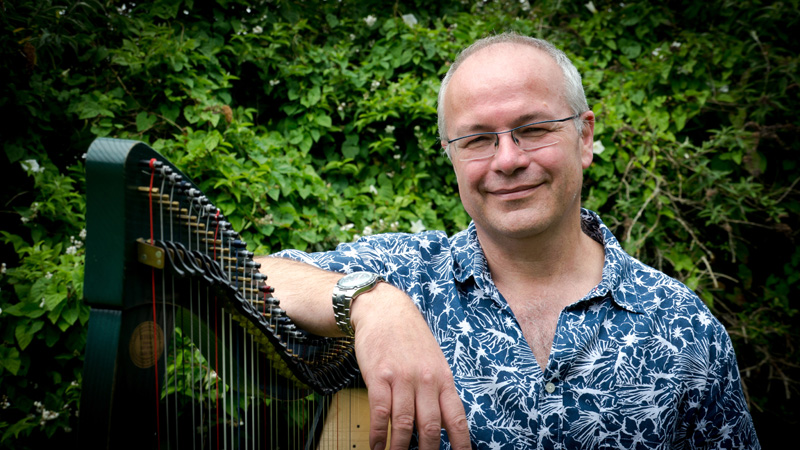
My work encompasses education, media production, music performance, music facilitation, and creativity.
I enjoy connections and think they’re increasingly important in a fragmented world. I hope this site will give you an insight into how I combine these various passions to help people get new insights.
Recently I have been developing and producing a range of video / audio / web media in collaboration with professionals working with young children throughout Gloucestershire, UK, to help them understand and benefit from music.
Following 23 years’ experience in the BBC in broadcast, production, training and leadership development, I graduated in the Ashridge Masters in Organisation Consulting in 2006 and for my disseration, explored ways of combining my musical and OD experience.
Working with one of my colleagues at Ashridge Consulting, I run workshops addressing creativity and strategy development through the use of musical and other artistic means, in groups, as a way not only of looking at these issues in a different way and thereby getting different data, but also as a way of allowing people to experience the power of free dialogue in groups towards a common, co-created goal – something all too rarely experienced in organisations. Think of it as teamwork at a very deep level.
Last, but not least, I play and teach solo harp and also perform with a 5-piece celtic band.
Mark: I came across your version of Caledonia and just loved it. Have you recorded it and, if so, which album/CD is it on.
I’m Scottish and live in Toronto and find that there is more than one folk group called Slainte….are you based in England or Scotland?
What a great voice Lynn has….what is her full name? Definitely my favourite version of Dougie McLean’s lovely song….would love to have the CD. Thanks, Mark
Hi there! There are quite a few bands called Slainte – you are right. We are in England and this is our website: http://www.celtmusic.co.uk
Lynne does have a lovely voice but she left the band a few years ago (only because she decided to retire from singing – nothing sinister!). But we do miss her. We lived in the same village and it was a treat to share car journeys to gigs and just have her singing in the car. It was wonderful!
The performance on the “Celtic Tradition” CD on our site is not as good as the video in the TV studio, which was done completely live in one take. So I hope it’s useful that I’ve extracted the audio from the original file from the video – download it for free here – Enjoy!: http://www.danceofdelight.com/Gallery/Audio/slainte-celtmusic-lynne-caledonia-audio.mp3
Hello from sunny California, Mark! I have just recently discovered your music. I would love to have scores of your arrangements for small harp, but cannot seem to find them anywhere. Can you direct me to a website where I might purchase them? Thank you, Cynthia
Hi Mark
I’m familiar with your name for many years, but most recently watched your video of “Stepping Out” on the Reigning Harps e-newsletter. I loved your ease and expression in playing and rhythmic variety of that piece.
That led me to explore your other videos and I found Parry’s Delight with teaching on arranging. I am a harpist, teacher and retailer of lever harps in Nanaimo, BC, Canada and send out a free email newsletter about 3x/yr to about 1100 subscribers, mostly in NA but some in Europe and other locations. I include a free music download with each newsletter and would love to include PD with your supporting video and credits. Do you have a printed version of the melody line already? otherwise could write it out from your audio if that’s OK with you.
Not sure if you are checking this site any longer – I’m on Facebook but don’t use it.
Look forward to hearing back from you – Alison Vardy
Hi dear Mark Harmer,
I am a lover of your playing by Paraguayan harp of La Partida! I can’t stop listening it.
Could you please tell me how can I find a cd including this work of you?
Thanks a lot
Mark,
Greetings from Ireland. I live in the town of Slane – which of course is Carolan Country.
I attended one of your courses in Wood Norton in 1994 – just after setting up my own training/music production business. I remember you as a sympathetic and supportive teacher on the subject of classical music production. Delighted to see that you have followed your passions for music and leadership development. My journey has been down similar paths – including documentaries for RTÉ Lyric FM and, in 2015, a Bronze Award at the New York Festival of Radio for a programme about Allegri’s Miserere and its provenance.
With every best wish,
Brian McIvor
Hi Brian,
Thank you so much for the lovely comment and for dropping by. Yes, still doing quite a lot of stuff – although I haven’t updated this site for a little while. Really enjoying doing some real-time music-making at the moment, even though with people who aren’t in the same room. It’s a lot of fun. Most of my leadership work tends to be with groups in real-time together, so that’s less easy to do remotely. But it’s been really fun getting on board the virtual stuff and helping people to create things.
Hi Mark,
I am a student film maker in Ireland. I was looking for some music to use as background music for a 10min documentary that I am making. I really enjoyed your harp music and I was wondering if I could get permission and pay you to use one of your tracks in a short documentary that I am making?
Thank you,
Heather
Hi Heather, thank you for asking – I will respond to you by email.
Hello Mark, I am a harpist and heard your arrangement of Carolyn’s Dream and am in love with it. Is it possible to purchase a copy of it?
Thank you, Alexandra Genova
Hi Alexandra, I have replied by email
Hello Mark,
Like many harpists, I am fond of the beautiful Si Bheag Si Mhor but the best-arranged version I have heard is yours, both pure and profound. (youtube 2007) So I am writing to know if by any chance it was possible to buy your partition ?
With regards,
Bleuenn
Hi Bleuenn,
I don’t think I have notated it, but it could be something I might do in the next day or so if that’s of interest.
Thank you for your answer!
Hi, In case this reaches you more easily than YouTube, could I please ask whether your ebony Hermine is still available, and how much you are selling or have sold it for?
Thank you for the YouTube video either way, as it has helped me to decide that a Hermine is probably a great option for me – a bit cheaper than the “more-than-I-ought-to-be-spending” options I had once been looking at, but still (if one hunts hard enough!) available with a beautiful finish – I have always had my heart set on a dark-coloured harp, though I know aesthetics shouldn’t be my main decision factor!
Hi Rachael – I’m incredibly sorry I never got actually to see this until just now. But yes, my Hermine harp has long gone. They are great Harps – very robust, and the Camac levers are fantastic.
Actually bought it to hire out to students, but then Covid hit and I decided it was pointless having it sit in a room unused. I’m so sorry I didn’t see this sooner, but I hope you have managed to find something!
Mark, I came across your arrangement and performance of Carolan’s Dream on YouTube. Do you have sheet music for that? I would like to use that to further arrange it for piano, violin and guitar.
I would be willing to pay for the arrangement.
Thanks,
John
Hi John,
Thank you so much for your interest in my arrangement of Carolan’s Dream. Like all my arrangements, it’s just something I worked out from the melody, and then once I was happy, that’s the arrangement I have used ever since. However, I have never written it down, because there didn’t really seem much point as it would only be me playing it! I have had a go at notating it in the past but honestly my notation skills aren’t very good and it just simply isn’t worth the time it would take me. I’m so sorry. Perhaps you can do an approximation by ear? I also like that everybody who plays these tunes does their own slightly different arrangements, and that to me as part of the ongoing process, and one of the reasons why Carolan’s music has survived so well. It gets reinterpreted with every arrangement, and to me that’s as it should be. Sounds like a bit of an excuse, I know, but that’s the other reason why I tend not to publish that many arrangements.